
Myopia, or nearsightedness, is a common eye condition that affects millions of people around the world. It makes it hard to see objects that are far away, but not those that are close by. In this article, we will explain what myopia is, what causes it, what types of myopia exist, how it can be diagnosed and treated, and what are the possible complications and prevention strategies.
What is myopia and what causes it?
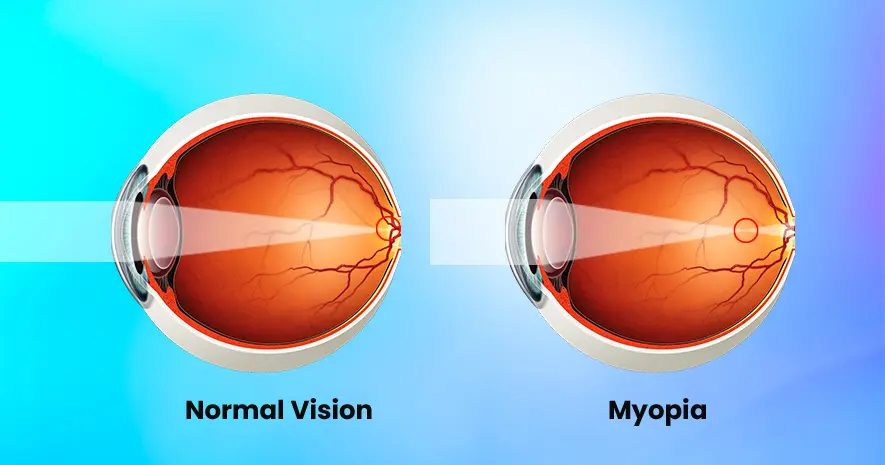
Myopia is a refractive error, which means that the eye does not bend or refract light correctly. Normally, when light enters the eye, it is focused on the retina, which is the light-sensitive layer at the back of the eye. The retina then converts the light into signals that are sent to the brain, which interprets them as images.
However, in myopia, the eyeball is too long or the cornea (the clear front surface of the eye) is too curved. This causes the light to focus in front of the light-sensitive area of the retina, instead of on it. As a result, the images that the retina sends to the brain are blurry and unclear.
The exact causes of myopia are not fully understood, but researchers believe that it is influenced by both genetic and environmental factors. Some of the risk factors for developing myopia include:
What are the types of myopia?
There are several types of myopia, depending on the severity and the associated eye problems. The most common types are:
How is myopia diagnosed and treated?
Myopia can be diagnosed by a complete eye check-up, which includes measuring the eye’s refractive error, examining the eye’s health, and testing the eye’s visual acuity. The eye doctor will use various instruments and tests, such as:
Myopia can be treated by wearing corrective lenses, such as glasses or contact lenses, or opting for laser surgery. Corrective lenses help to bend the light rays so that they focus on the retina, improving vision. Laser surgery reshapes the cornea to correct the refractive error, eliminating the need for glasses or contact lenses. However, laser surgery is not suitable for everyone, and it may have some risks and side effects, such as dry eyes, glare, or infection.
What are the possible complications and prevention strategies?
Myopia is not a life-threatening condition, but it can increase the risk of developing other eye diseases, especially in high or pathological myopia. Some of the possible complications include:
Myopia can be prevented or delayed by spending more time outdoors, reducing near work at very close distances and for extended periods, and having regular eye exams. These measures can help to reduce the eye strain and the environmental factors that contribute to myopia.
How can ayurveda help in managing myopia?
Ayurveda offers a holistic approach to managing myopia, which involves correcting the underlying doshic imbalances, strengthening the eye tissues, and improving the eye function. Some of the ayurvedic methods for managing myopia are:
Conclusion
Myopia is a common eye condition that can affect the quality of life and the eye health of many people. Ayurveda offers a holistic view on myopia and its management, which involves correcting the underlying doshic imbalances, strengthening the eye tissues, and improving the eye function. By following the ayurvedic methods, you can enhance your vision naturally and prevent or reduce the risk of complications.

October 16, 2026

October 09, 2026

September 24, 2026

September 19, 2026

September 18, 2026

September 03, 2026
We use cookies that are necessary for the smooth operation of the website, to improve our website and to display advertising relevant to you on social media platforms and partner websites. By clicking "Accept all", you agree to the use of cookies for convenience features and statistics and tracking. You can change these settings again at any time. If you do not agree, we will limit ourselves to technically necessary cookies. For more information, please see our privacy policy .