
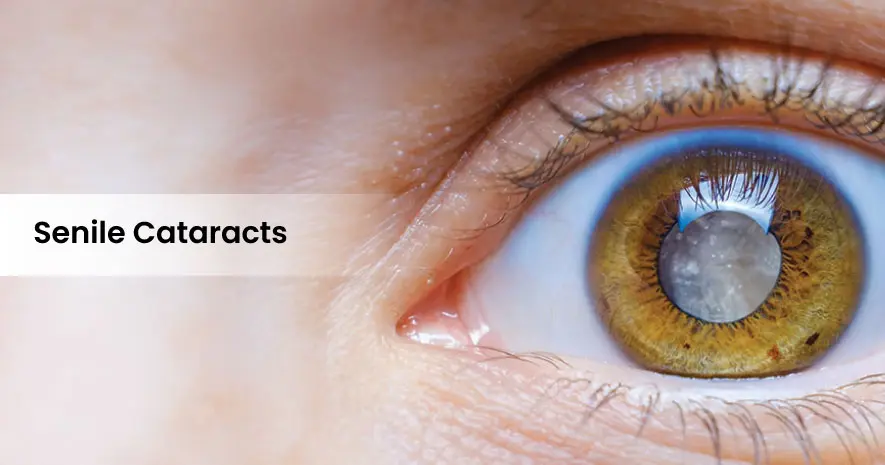
Senile cataracts, also known as age-related cataracts, are the most common form of lens opacity. They are defined as cataracts occurring in people over 50 years of age. This condition involves the natural lens of the eye gradually becoming cloudy with age, which blocks light from reaching the retina and leads to blurred and distorted vision.
Causes of Senile Cataracts
Ageing is the leading cause and the single most important risk factor for senile cataracts. Most people over the age of 60 years have some degree of cataract formation, and studies show a progressive increase in lens opacities with age. The mechanism of cataract formation is considered multifactorial. Research provides increasing evidence that oxidative stress plays an important role in the development of age-related cataract.
Risk Factors and Associated Conditions
In addition to age, several factors increase the risk for the development or acceleration of senile cataracts:
- Ultraviolet (UV) Radiation: Increased chance of cataract formation with unprotected exposure to UV radiation. Patients living in high UV-B radiation environments have a higher incidence. Long-term exposure to UV rays and occupational exposure to UV light increase risk.
- Diabetes Mellitus: Persons with diabetes are at a higher risk for cataracts.
- Smoking: An association between smoking and increased nuclear opacities has been reported. Smoking can accelerate cataract development.
- Alcohol: Several studies show increased cataract formation in patients with higher alcohol consumption.
- Systemic Diseases: Medical conditions such as hypertension can speed up cataract formation.
- Drugs: Certain medications, particularly corticosteroids, have been associated with posterior subcapsular cataracts.
- Nutrition: Studies suggest a potential association between cataract formation and low levels of antioxidants, such as vitamin C, vitamin E, and carotenoids.
- Family History: A positive family history is considered a common risk factor.
Symptoms of Senile Cataracts
Cataracts must cause a significant reduction in visual acuity or functional impairment to be considered clinically significant. The common hallmark symptoms of cataract are decreased vision and increased problems with glare.
Visual Impairment Symptoms
Blurry or Cloudy Vision: This is the most frequent symptom. Patients often describe feeling like they are constantly looking through a misted glass or a fogged-up window, making activities like reading, driving, and recognizing faces difficult.
Glare and Light Sensitivity (Photophobia): Patients experience increased difficulty with glare. Bright light sources, such as sunlight, car headlights, or indoor lighting, may cause discomfort and unsafe visual conditions, particularly during night driving.
Halos Around Lights: Rings or halos may appear around light sources, which is especially noticeable in dimly lit environments.
Faded or Yellowing Colors: Colors may lose their vibrancy, appearing yellowish or brownish, leading to color distortion.
Changes in Refractive Error: Shifts in refractive error may occur. The increasing optical density of the nucleus may cause myopia. This can lead to frequent changes in spectacle prescriptions.
Seeing Multiple Images (Diplopia/Polyopia): Patients may see multiple images or experience double vision in one eye
Reduced Contrast Sensitivity: Patients may experience vision problems, such as reduced visual acuity or contrast sensitivity, especially under low-contrast conditions.
Management
In Ayurvedic classics, visual disturbances are described in the context of three progressive stages: Timira, Kacha, and Linganasha
- Timira (Immature Cataract): This is the early stage, characterized by blurring or hazy vision.
- Kacha: If Timira is neglected, it progresses to Kacha, leading to further diminution of vision
- Linganasha (Mature Cataract): This is the last stage, resulting in complete vision loss, where the vision is totally obstructed.
Senile cataract is considered a Swabhava Balapravritta Vyadhi (a disease occurring by natural aging process). Therefore, treatment emphasizes Rasayana (rejuvenating) and Chakshushya (beneficial to the eye) properties to delay degenerative changes and restore fundamental bodily balance

1. Systemic Purification (Shodhana Chikitsa)
Prior to local therapies, purification procedures like Virechana Karma (Therapeutic Purgation) are often deemed mandatory to balance the aggravated Doshas
2. Oral Rejuvenation (Shamana and Rasayana)
Internal medications typically focus on anti-oxidant, rejuvenating, and metabolism-regulating properties:
Triphala-based medicines: Triphala (containing Amalaki, Haritaki, and Vibheetaki) plays an important role in cataract management. It is known to slow down cataract progression by restoring lowering oxidative stress.
Specific Rasayana Drugs:
Amalaki Rasayana: Used internally, Amalaki (Indian Gooseberry) is rich in Vitamin C, acting as a strong antioxidant and possessing aldose reductase inhibitory activity, which helps minimize free radical-induced damage
Nishamalki: Contains Haridra (Turmeric) and Amalaki. Haridra contains Curcumin, which has been found protective against cataract development and progression
Saptamruta lauha and Timirahara lauha: Indicated in Timira, possessing Tridoshahara and Chakshushya (eye-benefitting) properties
3. Local Eye Therapies (Kriyakalpas)
Topical applications allow for greater bioavailability and direct effect on ocular tissues.
Anjana (Collyrium): Application of collyrium is mentioned as an effective modality
Nasya Karma (Nasal Medication): Nasya is the administration of oils or ghrita through the nasal route. This procedure is suggested to stimulate the visual center in the brain via the olfactory neurological pathways, thereby improving vision
Akshitarpana: Application of medicated ghee over the eyes is indicated in Timira chikitsa
The goal of Ayurvedic intervention is early management of Timira to prevent its progression to the incurable stages or to avoid the need for high-risk surgical complication.

October 16, 2026

October 09, 2026

September 24, 2026

September 19, 2026

September 18, 2026

September 03, 2026
We use cookies that are necessary for the smooth operation of the website, to improve our website and to display advertising relevant to you on social media platforms and partner websites. By clicking "Accept all", you agree to the use of cookies for convenience features and statistics and tracking. You can change these settings again at any time. If you do not agree, we will limit ourselves to technically necessary cookies. For more information, please see our privacy policy .