
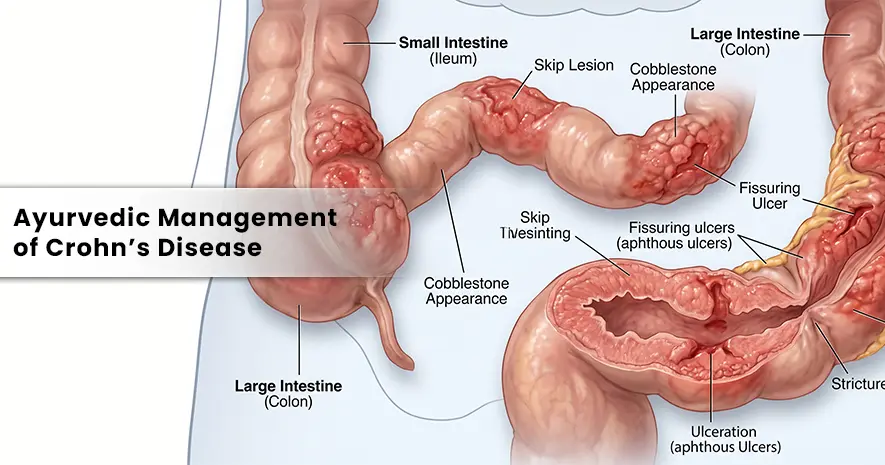
Crohn’s disease is a chronic, progressive, autoimmune inflammatory bowel disorder. It causes inflammation or systemic swelling in the digestive tract. Though it can occur anywhere along the tract from mouth to all the way down it most commonly targets the end of the small intestine and the start of the large intestine. According to Ayurvedic tradition, the manifestations of Crohn’s disease find their closest parallel in Grahani Roga, a chronic digestive dysfunction, or Raktaja Atisara, characterized by bloody stools.
In Ayurveda, the pathogenesis of conditions similar to Crohn’s is described through a framework of metabolic and energetic imbalances. The pathogenesis begins with Agnimandhya, where a weakened digestive fire serves as the initial catalyst for systemic imbalance. This metabolic dysfunction facilitates the buildup of Ama, the toxic, undigested waste that settles within the body. As these toxins accumulate, they manifest as Ama Drava Pureesha, characterized by loose and toxic bowel movements, while simultaneously driving the progression of inflammation along the intestinal mucosa.
In its chronic stages, the condition compromises Rasa Dhatwagni—the essential metabolic fire responsible for the primary nutritional fluid. This breakdown eventually hinders Dhatu Poshana, or the deep nourishment of bodily tissues. This resulting Dhatu Kshaya (tissue depletion) presents a challenging clinical picture: patients often experience Karshya (significant weight loss), Dourbalya (extreme physical weakness), Pandu (secondary anemia), and the cessation of menstrual cycles.
Though the disease involves all three Doshas, the long-term state is defined by a surge in Pitta and Rakta (blood). This inflammatory heat leads to painful mucosal ulcers, Daha (burning sensations), Mukha Paka (mouth sores), and Rakta Nisarana, the distressing occurrence of rectal bleeding.
Signs and Symptoms
Crohn’s disease can go far beyond mere stomachache as the inflammation can go deep and compromise the absorption of nutrients. The symptoms often come in cycles, alternating between active periods of intense symptoms (flares) and periods of complete quiet (remission).
● Diarrhea.
● Fever.
● Fatigue.
● Belly pain and cramping.
● Blood in the stool.
● Mouth sores.
● Reduced appetite and weight loss.
● Pain or drainage near or around the anus due to inflammation from a tunnel into the skin, called a fistula.
Crohn’s has two major features that set it apart from other digestive conditions:
1. The "Patchy" Pattern (Skip Lesions): Crohn’s does not typically spread evenly. Instead, it occurs in patches. A person might have a few inches of inflamed tissue, followed by a large section of completely healthy tissue, followed by another inflamed patch.
2. Deep Inflammation (Transmural): While some conditions only irritate the very surface lining of the gut, Crohn's inflammation is transmural. This means it penetrates through all the tissue layers of the intestinal wall, which can cause unique structural changes over time.
Treatment Aim According to Ayurveda
The Ayurvedic treatment goals for Crohn’s disease involve a comprehensive approach: clearing metabolic toxins through Ama Pachana, kindling and stabilizing the digestive fire via Agni Deepana, and managing hypermotility to improve absorption through Grahi and Stambhana. Furthermore, the protocol focuses on Rakta Sthambana to stop active bleeding and heal mucosal ulcers, ultimately leading to Grahani Bala Vardhana, which restores the structural strength and vitality of the intestinal walls.
At Sreedhareeyam, we use a specialized diet and panchakarma to manage Crohn’s disease.
● Takra Kalpana (Buttermilk Protocol): Takra is highlighted as therapeutic gold for Grahani. Its light (Laghu), dry (Ruksha), and sour-astringent properties kindle Agni, feed the gut microbiome, and correct the systemic iron metabolism cycle.
● Picha Basti: A highly specialized medicated enema administered directly to the colon, it acts as a topical anti-inflammatory (Shothahara) and wound-healer (Vrana Ropaka), clearing circulating inflammatory markers and stopping bleeding.
● Matra Basti: Lubricates the colon, pacifies Vata, and heals deeper transmural irritation to prevent stricture formation.
Diet for Crohn’s Disease
During an active Crohn's flare-up, the primary dietary objective is to minimize mechanical friction on the raw, inflamed intestinal lining using a low-residue, low-fiber, and easily digestible diet. This "rest and repair" phase relies on refined grains, skinless lean proteins (such as poultry and eggs), well-cooked and pureed vegetables, and healthy, easily absorbed fats like olive oil. Incorporating traditional Ayurvedic preparations such as Takra (fresh, light buttermilk whisked with cumin and ginger) and Laja (parched rice gruel) can accelerate healing by soothing the mucosal lining and preventing dehydration without taxing the digestive fire. Conversely, potential trigger foods that physically or chemically irritate the gut—including coarse insoluble fibers (raw vegetables, nuts, and seeds), high-fat fried foods, lactose-heavy dairy, caffeine, alcohol, and artificial sweeteners—must be strictly avoided to prevent cramping and worsening diarrhea.
Once active inflammation is controlled and you enter the remission phase, the focus shifts to expanding your diet, rebuilding nutrient stores, and feeding a healthy gut microbiome. Soluble fibers should be reintroduced gradually—one at a time—alongside foods rich in anti-inflammatory omega-3 fatty acids, such as salmon and walnuts, while maintaining a high daily fluid intake. Because chronic inflammation in the small intestine often leads to malabsorption, it is vital to monitor and supplement key depleted micronutrients, particularly Iron, Vitamin B 12, Calcium, Vitamin D, and Vitamin B9 (folic acid). Adopting long-term eating habits like consuming five to six small, frequent meals rather than three large ones, and chewing food thoroughly to a liquid state, will minimize the mechanical workload on your digestive tract and support lasting mucosal health.
Frequently Asked Question
1. Is Crohn’s disease genetic, and will I pass it on to my children?
If you have Crohn's disease, the risk of passing it to your child is relatively low. Studies estimate that a child has a roughly 5% to 10% chance of developing IBD if one parent has the condition. If both parents have IBD, the risk rises to over 30%
2. Can I manage or cure Crohn’s disease through diet alone?
While dietary changes are incredibly powerful for symptom control, mucosal soothing, and correcting nutrient deficiencies, diet alone cannot cure Crohn's disease. Because Crohn’s is a systemic, immune-mediated disease, dietary modifications cannot entirely halt the underlying microscopic autoimmune attack.
3. Can I live a normal life with Crohn’s Disease?
The short answer is yes, you can live a long, vibrant, and normal life. Crohn’s disease is a chronic, lifelong condition, but it is not considered a fatal illness. By staying consistent with maintenance medications, identifying your personal dietary triggers, managing stress, and regular treatment, you can successfully prevent flares, avoid hospitalizations, and pursue your career, travel, sports, and family goals without limitations.
July 23, 2026
July 17, 2026

July 14, 2026

July 09, 2026
June 18, 2026

June 08, 2026

June 04, 2026

June 04, 2026
May 30, 2026
May 26, 2026

May 18, 2026
We use cookies that are necessary for the smooth operation of the website, to improve our website and to display advertising relevant to you on social media platforms and partner websites. By clicking "Accept all", you agree to the use of cookies for convenience features and statistics and tracking. You can change these settings again at any time. If you do not agree, we will limit ourselves to technically necessary cookies. For more information, please see our privacy policy .