
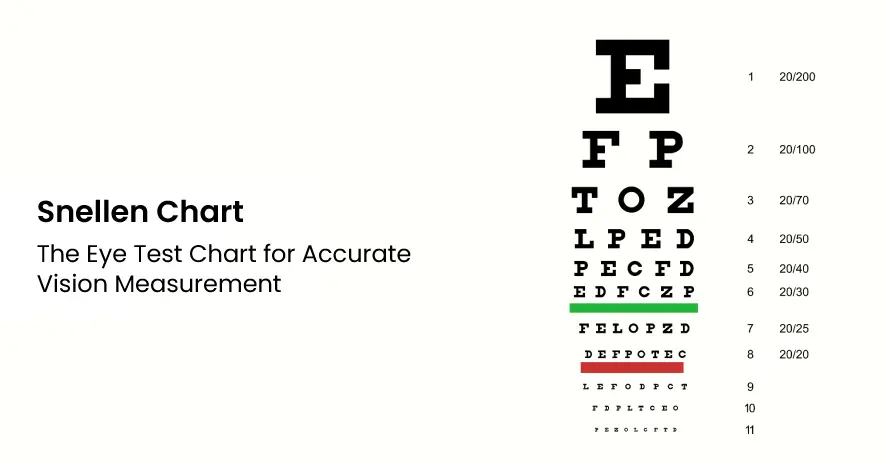
Step into any doctor's office or eye specialist's clinic, and you'll likely be greeted by one of the most recognizable posters in the world: the Snellen eye chart. That ubiquitous display of block letters, starting large and getting progressively smaller, is more than just a piece of medical décor—it's a crucial tool that revolutionized the way we measure and understand vision.
But what exactly is the Snellen chart, and how does it translate those seemingly random letters into a measurement of your sight? Let's take a closer look at this remarkable invention.
The Genius of Dr. Herman Snellen
Before the mid-19th century, measuring visual acuity—the sharpness or clarity of vision—was surprisingly vague. Eye doctors used various non-standard methods, from counting mustard seeds to reading passages in different typefaces. There was no consistent way to compare one person's vision to another's.
That all changed in 1862 when Dutch ophthalmologist Dr. Herman Snellen introduced his standardized eye chart. Working under his colleague Dr. Franciscus Donders, who needed a way to implement a formula for defining standard vision, Snellen designed a chart with a specific, revolutionary geometry.
The key to the Snellen chart lies in its letters, or "optotypes." These aren't just any font; they are specially designed so that the thickness of the lines and the thickness of the white spaces between them are precisely one-fifth of the total letter height.
How to Read the Numbers: Understanding the Snellen Fraction
The most important takeaway from your eye chart test is your visual acuity score, usually expressed as a fraction, such as 20/20 (in the U.S. system) or 6/6 (in the metric system).
The Snellen fraction is essentially a comparison of your vision to what's considered "normal" or "standard" vision.
● The Numerator (Top Number): This represents the distance (in feet or meters) you stood from the chart. The standard distance is 20 feet (or 6 meters).
● The Denominator (Bottom Number): This represents the distance (in feet or meters) a person with standard vision can stand to read the same line you correctly read.
What does "6/6 Vision" really mean?
If your visual acuity is 6/6, it means that you can see at 6 meters what an average person with standard vision can also see at 6 meters. It is the benchmark for clear vision at a distance.Many people, particularly younger individuals with healthy eyes, can achieve even better results, such as 6/5 or 6/4.
What about other scores?
| Visual Acuity Score (Metric) | Imperial Equivalent | What It Means |
|---|---|---|
| 6/6 | 20/20 | Normal Vision. You see clearly at 6 meters what a normal eye sees at 6 meters. |
| 20/40 | 20/40 | Poorer Vision. You must be at 6 meters to see a letter that a person with 6/6 vision could see clearly from 12 meters away. Your vision is half as good as the standard. |
| 6/60 | 20/200 | Significantly Reduced Vision. This is often the largest letter at the top of the chart. You must be at 6 meters to see a letter that a normal eye could see from 60 meters away. In many places, this score (or worse, with correction) is a criterion for legal blindness. |

October 16, 2026

October 09, 2026

September 24, 2026

September 19, 2026

September 18, 2026

September 03, 2026
We use cookies that are necessary for the smooth operation of the website, to improve our website and to display advertising relevant to you on social media platforms and partner websites. By clicking "Accept all", you agree to the use of cookies for convenience features and statistics and tracking. You can change these settings again at any time. If you do not agree, we will limit ourselves to technically necessary cookies. For more information, please see our privacy policy .